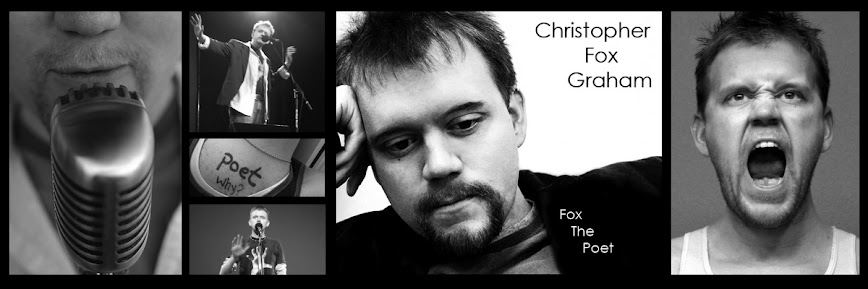
This is the official blog of Northern Arizona slam poet Christopher Fox Graham. Begun in 2002, and transferred to blogspot in 2006, FoxTheBlog has recorded more than 1.6 million views since 2009. This blog cover's Graham's poetry, the Arizona poetry slam community and offers tips for slam poets from sources around the Internet. Read CFG's full biography here. Looking for just that one poem? You know the one ... click here to find it.
The Sedona Poetry Slam’s 18th season continues Saturday Dec. 5 with a change of scenery: the second slam of the year shifts down the hall to the Alice Gill-Sheldon Theatre starting at 7:30 p.m. Performance poets will bring high-energy competitive spoken word to the intimate room for one night only before the slam returns to its usual home in the new year.
With the holidays closing in poets are expected to bring everything from wry gift-giving satire to reflective end-of-year verse as they compete for cash prizes and bragging rights.
Open Slam
A poetry slam is like a series of high-energy three-minute one-person plays judged by the audience. Slam poetry is an art form that allows written page poets to share their work alongside theatrical performers hip-hop artists and lyricists.
Poets come from as far away as Phoenix Tucson Prescott and Flagstaff competing against local poets from Sedona and Cottonwood college poets from Northern Arizona University and youth poets from Verde Valley high schools. All types of poetry are welcome on the stage from street-wise hip-hop and narrative performance poems to political rants and introspective confessionals. Any poem is a “slam” poem if performed in a competition. All poets get three minutes per round to entertain and inspire the audience with their creativity.
Anyone can sign up to compete in the slam for the $75 grand prize and $25 second-place prize. To compete in the slam poets will need three original poems each lasting no longer than three minutes. No props costumes nor musical accompaniment are permitted. The poets are judged Olympics-style by five members of the audience selected at random at the beginning of the slam.
Email host Christopher Fox Graham at foxthepoet@yahoo.com to sign up early to compete or by the Friday before the slam or sign up at the door the day of the slam. Poets who want to compete should purchase a ticket in case the roster is filled before they arrive.
Tickets and Venue
The Alice Gill-Sheldon Theatre is located at 2030 W. SR 89A in West Sedona in the same complex as the Mary D. Fisher Theatre. Tickets are $12 in advance or $15 at the door. For tickets call 928-282-1177 or visit SedonaFilmFestival.org.
Upcoming Slams
The next poetry slams will be held on Saturdays, Feb. 13, March 6, April 17 and May 22 at the Mary D. Fisher Theatre.
The prize money is funded in part by a donation from Verde Valley poetry supporters Jeanne and Jim Freeland.
For more information visit sedonafilmfestival.com or foxthepoet.blogspot.com. For a full list of slam poetry events in Arizona visit azpoet.com or the Arizona State Poetry Society at azpoetry.net..
What is Poetry Slam?
Founded at the Green Mill Tavern in Chicago in 1984 by Marc Smith poetry slam is a competitive artistic sport designed to get people who would otherwise never go to a poetry reading excited about the art form when it becomes a high-energy competition. Poetry slams are judged by five randomly chosen members of the audience who assign numerical value to individual poets’ contents and performances.
Poetry slam has become an international artistic sport with more than 100 major poetry slams in the United States Canada Australia and Western Europe. Slam poets have opened at the Winter Olympics performed at the White House and at the United Nations General Assembly and were featured on “Russell Simmons’ Def Poets” on HBO.
Sedona has sent four-poet teams to represent the city at the National Poetry Slam in Charlotte N.C. Boston Cambridge Mass. Oakland Calif. Decatur Ga. Denver and Chicago.
The Sedona Poetry Slam opens its 18th season on Saturday, Oct. 10, with a twist: The first slam of the year takes the stage on the set of “The Dead Quilters Society,” the play being staged at the Mary D. Fisher Theatre that weekend and the next. Performance poets will bring high-energy, competitive spoken word to the theater starting at 7:30 p.m.
Poets will compete for cash prizes on a set built for the popular Sedona historical play — a collision of page, stage and improvised scenery that regulars say only adds to the show.
Open Slam
A poetry slam is like a series of high-energy three-minute one-person plays judged by the audience. Slam poetry is an art form that allows written page poets to share their work alongside theatrical performers hip-hop artists and lyricists.
Poets come from as far away as Phoenix Tucson Prescott and Flagstaff competing against local poets from Sedona and Cottonwood college poets from Northern Arizona University and youth poets from Verde Valley high schools. All types of poetry are welcome on the stage from street-wise hip-hop and narrative performance poems to political rants and introspective confessionals. Any poem is a “slam” poem if performed in a competition. All poets get three minutes per round to entertain and inspire the audience with their creativity.
Anyone can sign up to compete in the slam for the $75 grand prize and $25 second-place prize. To compete in the slam poets will need three original poems each lasting no longer than three minutes. No props costumes nor musical accompaniment are permitted — except, for this one night, the play’s own quilting-themed backdrop, which stays put. The poets are judged Olympics-style by five members of the audience selected at random at the beginning of the slam.
Email host Christopher Fox Graham at foxthepoet@yahoo.com to sign up early to compete or by the Friday before the slam or sign up at the door the day of the slam. Poets who want to compete should purchase a ticket in case the roster is filled before they arrive.
Tickets and Venue
The Mary D. Fisher Theatre is located at 2030 W. SR 89A Suite A-3 in West Sedona. Tickets are $12 in advance or $15 at the door. For tickets call 928-282-1177 or visit SedonaFilmFestival.org.
Upcoming Slams
The next poetry slams will be held on Saturdays, Dec. 5 at the Alice Gill-Sheldon Theatre, and Feb. 13, March 6, April 17 and May 22 at the Mary D. Fisher Theatre.
The prize money is funded in part by a donation from Verde Valley poetry supporters Jeanne and Jim Freeland.
For more information visit sedonafilmfestival.com or foxthepoet.blogspot.com. For a full list of slam poetry events in Arizona visit azpoet.com or the Arizona State Poetry Society at azpoetry.net..
What is Poetry Slam?
Founded at the Green Mill Tavern in Chicago in 1984 by Marc Smith poetry slam is a competitive artistic sport designed to get people who would otherwise never go to a poetry reading excited about the art form when it becomes a high-energy competition. Poetry slams are judged by five randomly chosen members of the audience who assign numerical value to individual poets’ contents and performances.
Poetry slam has become an international artistic sport with more than 100 major poetry slams in the United States Canada Australia and Western Europe. Slam poets have opened at the Winter Olympics performed at the White House and at the United Nations General Assembly and were featured on “Russell Simmons’ Def Poets” on HBO.
Sedona has sent four-poet teams to represent the city at the National Poetry Slam in Charlotte N.C. Boston Cambridge Mass. Oakland Calif. Decatur Ga. Denver and Chicago.
What is Spoken Word? Is it really hip hop??? One thing that’s certain is that more and more hip hop fans are allowing Spoken Word into their cribs. Does Spoken Word have what it takes to make it mainstream?
Poetry slam; ideas of dimly lit cafes, mahogany tables, free spirited individuals of all colors, dreadlocked hair humbly standing on a stage in front of others like them, speaking of oppression, struggle, history, and truth - Not exactly the image that record labels try to market within the rap and hip hop genre, huh? But despite not being the most known sect of hip hop, spoken word continues to push forward through the waves of marketable mainstream music and make its’ presence felt within the worldwide urban community.
Now, before we can hop into the “locks” of spoken word, we need to travel right to the roots and explore the core of the art, and the long history which surrounds spoken word poetry. The true essence of music isn’t built on the instrumentals, or flashy marketable stereotypes, and infectious hooks; instead the essence of music finds its’ roots right within the words, and in order to take an actual look into the heart of music we have to look past the catchy beats, and “blinged” filled videos, and peer right into the words that the artist speaks… hence, spoken word. Simply seeing the term, “spoken word”, images of a lone man or woman on stage with nothing but a microphone, and a voice box to produce rhythm come to mind, allowing us to relive a moment in time, or experience an emotion; that essentially is the definition of Spoken Word poetry, the act of reading a literary work or poem out loud. However, we have to keep in mind that Spoken Word poets do not necessarily follow the conventional “guidelines” of poetry (remember trying to count syllables and stanzas in the back of your grade 11 English class during the poetry unit?). Guidelines don’t exist within Spoken Word, instead a different approach is taken, which offers a more free flowing, and open ended style of poetry where there are no real limitations, and a poet is essentially able to do what they please. In fact, Spoken Word extends itself into all different artistic styles, ranging from the recitals and performances of poetic works by Shakespeare and further manifesting itself into hip hop music, all through the use of rhythm and words. As far as looking at where it all started, there really isn’t a specific time, or group that opened up the world of Spoken Word, but it can be said that it’s most basic form has existed for centuries, ever since mankind learned how to communicate with those vocal chords (Rahzel would have had his own shrine back then). But, we can still attribute the creation of Spoken Word back to times of ancient chants, and tribal story telling that have swayed generations, which really is the epitome and true primal nature of Spoken Word, the act of communicating with others through words.
Let’s just say that we’ve come a long way from circle fires and loincloths. Throughout the past years Spoken Word has flourished and continued to expand outwards, and along with its’ nature of being flexible and limitless, it has been able to open up its’ doors to artists from all paths of life. Within the realm of Spoken Word, there are no credentials, styles or certain images artists have to uphold, instead just being oneself is enough to move and connect with a crowd on levels of mind, and body. How often is it we experience an individual who has lived through the struggles of the streets, and a teacher living in the suburbs swaying the same crowd, and sharing the same stage? Just compare the works of Spoken Word artist, Rives, and Black Ice, that’s love right there! And when it comes down to it, hip hop and Spoken Word go together hand in hand, both carrying the same underlying meaning, giving individuals a medium to project ones’ feelings, and emotions, while creating a connection with a diverse crowd that isn’t limited by race, sex, or social class; in a sense, Spoken Word is like hip hop’s little brother, tagging along singing the same concept of spreading a message.
Of course, as Spoken Word has expanded greatly into urban communities it has become more recognized within the media and gained a whole new fan base outside of the “poet’s corner”, but we have to keep in mind that with moving comes luggage, and with the exposure to mainstream media, Spoken Word is seeing its’ fair share of misconceptions. The word poetry itself carries a little negative connotation for much of mainstream society, who see it as being too “sensitive”, or geared more towards a “conscious” crowd, which makes the integration of Spoken Word into the mainstream more difficult. As long as people carry a negative preconceived notion of what Spoken Word poetry is, there isn’t much room for reaching other crowds. However, these stereotypical views of Spoken Word Poetry are beginning to be lifted, along with the support of hip hop heavyweight, Russell Simmons, and his HBO television series, Def Poetry Jam, Spoken Word is taking a break from the incense filled rooms, and coffee shops to appear on a more national stage. With major hip hop figures like Kanye West, Talib Kweli, and Common lending performances, along with Def Poetry Jam’s current host, Mos Def, Spoken Word is being embraced into the hip hop community with open arms, and rightfully so. The incorporation of hip hop artists into Spoken Word allows us to see how well both styles compliment each other, sharing a connection of the importance of words and rhythm, as well as the connection between the artist and crowd. The similarities that hip hop and Spoken word share allow both fans and artists alike to comfortably step in and indulge in both styles. Fact is, at the end of the day whether you are reciting a poem, or dropping 16 bars, it all comes down to man and his microphone.
Although Spoken Word seems to be finding a home within the hip hop community, there still is the question of whether or not there is any room for Spoken Word artists, and their microphones in the world of commercial and mainstream hip hop? Even with Def Poetry Jam opening up doors for the Spoken Word community, the art still finds itself confined to a less mainstream crowd, making it difficult for the artists of Spoken Word to get heard. While major record labels dominate the market, and promote marketable images to different fan bases, Spoken Word currently suffers mainly due to it being less understood by most of the mainstream, and not being as easily marketable. Although Spoken Word still has a large fan base for itself, as well as a mass group of hip hop fans to carry it further, it still is considered an “acquired taste” by mainstream standards.
However, with commercialization also comes controversy, making Spoken Word’s slow progression into mainstream media somewhat helpful. We can’t deny that in the earlier days hip hop was at it’s peak as one unified art, but through dominance of major record labels, and the need to sell units, the rap and hip hop genre became plagued with accusations of becoming “too commercial”, or “selling out”, causing fans and artists to separate into mainstream and underground, ultimately hurting the hip hop community– “Mo’ Money, Mo’ Problems” anyone?. Of course, the debate of “Who Killed hip hop?” seems never ending, but in spite of the commercialization of urban music, there still is a glimmer of hope that we see through many Hip hop artists that stay true to the art. While Spoken Word poetry, may, or may not go through the same pressure of commercialization, the entire hip hop community needs to continue to lend a helping hand in order to keep hip hop a true art form, and from there it can only grow bigger. And that is what the hip hop community needs at a time like this, growth.
Whether people have taken time to realize it or not, Spoken Word, graffiti writing, emceeing, B-Boying, and everything else in between has stemmed right from the same root, and all these branches share an equal level of importance that all contributed to the building of one main element, which is hip hop itself. Thus, for hip hop to grow, we as a community, and as a culture need to grow along with it, and break down the barriers and images hip hop carries in order to make one unified front. Whether it’s freestyling, or Spoken Word, we all have to embrace these styles with an open mind, and work to bettering hip hop as a whole. So, how can we best sum up this need for a communion with in hip hop? Well, Spoken Word artist, Anubis the Necro Nubian, best says it as, “A big ol honkin’ photo of Mohammed Ali, Gil Scott, Martin Luther King, MC Shan, Clive Clambel, Q-Tip, Che Guevera, Zack DeLa Rocha and Saul Williams all holding hands and singing along to the Age of Aquarius.”